TrainerSpotting
Improving personal trainer visibility
Improving Personal Trainer visibility
This project began from observing my brother, Roko, a personal trainer struggling to grow his client base in Split, Croatia, despite being experienced and dedicated.
Like many independent trainers, he relied mostly on social media and word-of-mouth methods that favored those with marketing skills rather than professional expertise. His challenge sparked a broader question:
How can we help skilled trainers become visible and accessible without turning them into full-time marketers?
This project began from observing my brother, Roko, a personal trainer struggling to grow his client base in Split, Croatia, despite being experienced and dedicated.
Like many independent trainers, he relied mostly on social media and word-of-mouth methods that favored those with marketing skills rather than professional expertise. His challenge sparked a broader question:
How can we help skilled trainers become visible and accessible without turning them into full-time marketers?


Project type
Personal UX/UI project
Personal UX/UI project
Date
December 2024, March-April 2026
December 2024, March-April 2026
Role
UX/UI Designer, Researcher
UX/UI Designer, Researcher
Tools
Figma, Figjam, Google Forms, Maze
Figma, Figjam, Google Forms, Maze
Problem Statement
Personal trainers face limited visibility and credibility in a saturated fitness market. While many are qualified, their online presence depends on algorithms and personal promotion. This creates an imbalance where marketing ability outweighs professional quality.
The challenge was to design solutions, both offline and digital, that help trainers build visibility, trust, and meaningful client relationships.
Personal trainers face limited visibility and credibility in a saturated fitness market. While many are qualified, their online presence depends on algorithms and personal promotion. This creates an imbalance where marketing ability outweighs professional quality.
The challenge was to design solutions, both offline and digital, that help trainers build visibility, trust, and meaningful client relationships.
Solutions
Non-digital:
Non-digital:
Partnering with local gyms and cafés to host free trial sessions or open fitness days.
Partnering with local gyms and cafés to host free trial sessions or open fitness days.
Using branded QR cards that link directly to a trainer’s contact or review page.
Using branded QR cards that link directly to a trainer’s contact or review page.
Organizing small community events where trainers exchange advice and demonstrate expertise.
Organizing small community events where trainers exchange advice and demonstrate expertise.
Digital
Digital
A platform that connects trainers and clients through verified profiles, clear pricing, reviews that removes the friction of social media messaging and inconsistent branding.
A platform that connects trainers and clients through verified profiles, clear pricing, reviews that removes the friction of social media messaging and inconsistent branding.
Research
To understand the issue from both perspectives, I conducted the following primary and secondary research with trainers and clients.
To understand the issue from both perspectives, I conducted the following primary and secondary research with trainers and clients.
Interviews with trainers and clients
Interviews with trainers and clients
Surveys to discover the market's preferences
Surveys to discover the market's preferences
Articles and social media posts from professionals
Articles and social media posts from professionals
The goal was to uncover patterns in how trainers promote themselves and how clients choose who to trust.
The goal was to uncover patterns in how trainers promote themselves and how clients choose who to trust.
User Perspectives
I focused on both perspectives to see how each side experiences the same issue from opposite ends. Through my research, I learned that while trainers struggle to be seen, clients struggle to trust.
I focused on both perspectives to see how each side experiences the same issue from opposite ends. Through my research, I learned that while trainers struggle to be seen, clients struggle to trust.
Trainers
Trainers
Clients
Clients
“It’s hard to promote myself! I’m not a marketing expert.”
“It’s hard to promote myself! I’m not a marketing expert.”
“I never know who to trust when looking online.”
“I never know who to trust when looking online.”
“Most of my clients come from word-of-mouth or referrals.”
“Most of my clients come from word-of-mouth or referrals.”
“I prefer asking friends for recommendations instead of searching.”
“I prefer asking friends for recommendations instead of searching.”
“I post online but it rarely converts into actual clients.”
“I post online but it rarely converts into actual clients.”
“Many trainer profiles look similar. It’s hard to compare.”
“Many trainer profiles look similar. It’s hard to compare.”
Trainer interview questions
Trainer interview questions
Client interview questions
Client interview questions
Trainers
“It’s hard to promote myself! I’m not a marketing expert.”
“Most of my clients come from word-of-mouth or referrals.”
“I post online but it rarely converts into actual clients.”
Trainer interview questions
Clients
“I never know who to trust when looking online.”
“I prefer asking friends for recommendations instead of searching.”
“Many trainer profiles look similar. It’s hard to compare.”
Client interview questions
Even though both groups share the same goal - to connect effectively, their pain points come from opposite directions:
Even though both groups share the same goal - to connect effectively, their pain points come from opposite directions:
Trainers want to be visible without becoming marketers.
Trainers want to be visible without becoming marketers.
Clients want to find credible trainers without endless searching.
Clients want to find credible trainers without endless searching.
View the Trainer Affinity map
View the Trainer Affinity map
View the Client Affinity map
View the Client Affinity map
Key Findings
From both sides, several key themes consistently appeared throughout my research:
From both sides, several key themes consistently appeared throughout my research:
Trainers depend on algorithms and personal promotion, limiting their exposure.
Trainers depend on algorithms and personal promotion, limiting their exposure.
Clients rely more on recommendations than digital marketing content.
Clients rely more on recommendations than digital marketing content.
Pricing and offer transparency are inconsistent.
Pricing and offer transparency are inconsistent.
Verified profiles, reviews and professionality build stronger trust.
Verified profiles, reviews and professionality build stronger trust.
Synthesis
Mapping user feedback into patterns revealed one central insight: visibility and credibility are two sides of the same problem.
Mapping user feedback into patterns revealed one central insight: visibility and credibility are two sides of the same problem.
Trainers need structured visibility and clients need reliable information. Both would benefit from a unified platform that connects skill with trust.
Trainers need structured visibility and clients need reliable information. Both would benefit from a unified platform that connects skill with trust.
These findings became the foundation for the next phase - exploring non-digital actions and a digital platform that could work together to help trainers stand out and connect with clients effectively.
These findings became the foundation for the next phase - exploring non-digital actions and a digital platform that could work together to help trainers stand out and connect with clients effectively.
View the Client Affinity map
Shot from my brother's promotional video

Non-Digital Solution
Before jumping into the digital concept, I wanted to explore how visibility could improve without an app — through simple, local actions that trainers could implement immediately.
Before jumping into the digital concept, I wanted to explore how visibility could improve without an app — through simple, local actions that trainers could implement immediately.
During interviews, majority expressed frustration about relying only on social media to reach new clients. That insight opened up the question: "How to get visibility offline?"
During interviews, majority expressed frustration about relying only on social media to reach new clients. That insight opened up the question: "How to get visibility offline?"
Shot from my brother's promotional video
Community-Driven Visibility
Trainers already have strong relationships with their local networks, yet they often miss opportunities to leverage those relationships strategically.
Trainers already have strong relationships with their local networks, yet they often miss opportunities to leverage those relationships strategically.
By reconnecting with nearby spaces and communities, they can expand their visibility in an organic, authentic way.
By reconnecting with nearby spaces and communities, they can expand their visibility in an organic, authentic way.
These are some of the ideas I explored:
These are some of the ideas I explored:
Local partnerships
Local partnerships
Collaboration with nearby gyms and cafés to host short “open training” sessions or mini events.
Collaboration with nearby gyms and cafés to host short “open training” sessions or mini events.
Referral cards with QR codes
Referral cards with QR codes
Simple printed cards that link directly to the trainer’s profile or booking page.
Simple printed cards that link directly to the trainer’s profile or booking page.
Community workshops
Community workshops
Group fitness demos or nutrition talks that naturally build trust and awareness.
Group fitness demos or nutrition talks that naturally build trust and awareness.
These actions don’t require extra marketing skills, just initiative and structure. They create real-world credibility and complement any digital presence later on.
These actions don’t require extra marketing skills, just initiative and structure. They create real-world credibility and complement any digital presence later on.
The outcome is twofold:
The outcome is twofold:
Offline visibility builds trust.
Offline visibility builds trust.
Online visibility sustains reach.
Online visibility sustains reach.
In conclusion, while these ideas build awareness locally, the reach has still remained limited. This realization led to the next phase — exploring a digital solution that could extend the same sense of credibility and visibility into a wider, scalable platform.
In conclusion, while these ideas build awareness locally, the reach has still remained limited. This realization led to the next phase — exploring a digital solution that could extend the same sense of credibility and visibility into a wider, scalable platform.
Digital Solution
Digital Solution
Community-Driven Visibility
Trainers already have strong relationships with their local networks, yet they often miss opportunities to leverage those relationships strategically.
By reconnecting with nearby spaces and communities, they can expand their visibility in an organic, authentic way.
These are some of the ideas I explored:
Local partnerships
Collaboration with nearby gyms and cafés to host short “open training” sessions or mini events.
Referral cards with QR codes
Simple printed cards that link directly to the trainer’s profile or booking page.
Community workshops
Group fitness demos or nutrition talks that naturally build trust and awareness.
These actions don’t require extra marketing skills, just initiative and structure. They create real-world credibility and complement any digital presence later on.
The outcome is twofold:
Offline visibility builds trust.
Online visibility sustains reach.
In conclusion, while these ideas build awareness locally, the reach has still remained limited. This realization led to the next phase — exploring a digital solution that could extend the same sense of credibility and visibility into a wider, scalable platform.
While the non-digital initiatives created trust locally, they couldn’t provide long-term visibility or scale.
The next step was to explore how a digital platform could extend that trust, giving trainers lasting exposure, structure, and connection to new clients beyond their immediate circles.
While the non-digital initiatives created trust locally, they couldn’t provide long-term visibility or scale.
The next step was to explore how a digital platform could extend that trust, giving trainers lasting exposure, structure, and connection to new clients beyond their immediate circles.
The goal was to build a system where skill and credibility matter more than marketing ability.
The goal was to build a system where skill and credibility matter more than marketing ability.
Purpose
This digital concept is designed to help trainers be seen, trusted, and contacted easily, while helping clients find, evaluate, and reach out confidently. It acts as a bridge between the two sides: professional yet personal, transparent yet motivating.
This digital concept is designed to help trainers be seen, trusted, and contacted easily, while helping clients find, evaluate, and reach out confidently. It acts as a bridge between the two sides: professional yet personal, transparent yet motivating.
It would include these 3 core design principles:
It would include these 3 core design principles:
Clarity
Clarity
No clutter, no hidden features but direct access to relevant information.
No clutter, no hidden features but direct access to relevant information.
Credibility
Credibility
Verified profiles, certifications, and client reviews front and center.
Verified profiles, certifications, and client reviews front and center.
Connection
Connection
Built-in booking tools and communication that simplify the process.
Built-in booking tools and communication that simplify the process.
How would it work?
Trainers can create a profile showcasing their experience, certifications, and approach while clients can browse, filter, and compare verified professionals nearby. It would contain direct in-app scheduling that removes the friction of jumping between apps.
Trainers can create a profile showcasing their experience, certifications, and approach while clients can browse, filter, and compare verified professionals nearby. It would contain direct in-app scheduling that removes the friction of jumping between apps.
Key user flows would include:
Key user flows would include:
Discovery
Discovery
Clients find trainers by specialty, rating, or location.
Clients find trainers by specialty, rating, or location.
Evaluation
Evaluation
Clear profile details, reviews, and verified badges.
Clear profile details, reviews, and verified badges.
Retention
Built-in feedback loops to help trainers grow their reputation.
Connection
Retention
Connection
Secure booking options within the app.
Built-in feedback loops to help trainers grow their reputation.
Connection
Secure booking options within the app.
Product structure
After defining the initial concept for platform, the next step was translating the idea into a functional product structure, which turned into TrainerSpotting. The goal was to design an application that supports both sides of the platform: clients looking for trainers and trainers managing their sessions.
After defining the initial concept for platform, the next step was translating the idea into a functional product structure, which turned into TrainerSpotting. The goal was to design an application that supports both sides of the platform: clients looking for trainers and trainers managing their sessions.
To explore the structure and interaction patterns, the first step was creating wireframes.
These wireframes helped define the core navigation and main flows of the application before moving into visual design.
To explore the structure and interaction patterns, the first step was creating wireframes.
These wireframes helped define the core navigation and main flows of the application before moving into visual design.
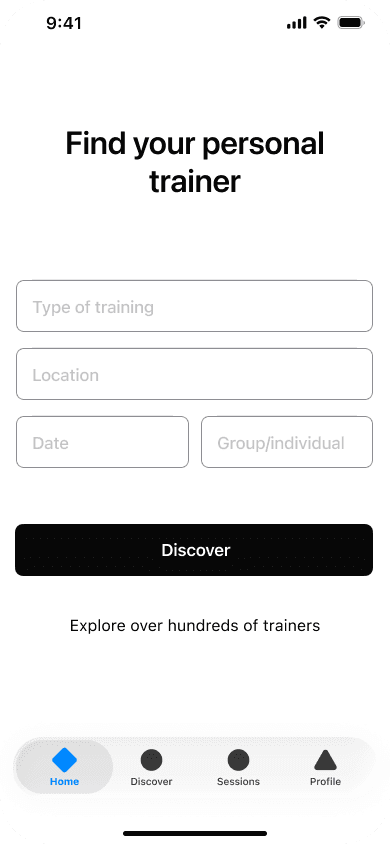


Wireframes used to define the core structure and navigation of the application.
Wireframes used to define the core structure and navigation of the application.
Designing for two user roles
TrainerSpotting was designed to support two different user roles within the same application.
Clients primarily use the platform to discover trainers and book sessions, while trainers need tools to manage their schedules and clients.
Because of this, the navigation and features were structured around two main perspectives.
TrainerSpotting was designed to support two different user roles within the same application.
Clients primarily use the platform to discover trainers and book sessions, while trainers need tools to manage their schedules and clients.
Because of this, the navigation and features were structured around two main perspectives.
Client flows
Client flows
Trainer flows
Trainer flows
Discovering trainers
Discovering trainers
Viewing and organizing training schedules
Viewing and organizing training schedules
Browsing trainer profiles
Browsing trainer profiles
Adding new training sessions
Adding new training sessions
Checking availability
Checking availability
Managing client lists
Managing client lists
Booking training sessions
Booking training sessions
Switching between trainer and client modes if needed
Switching between trainer and client modes if needed
Managing upcoming sessions
Managing upcoming sessions
Managing upcoming sessions
The main design challenge was keeping both roles clear and intuitive while allowing users to move between them without confusion.
The main design challenge was keeping both roles clear and intuitive while allowing users to move between them without confusion.

Application structure designed to support both client and trainer interactions.
Application structure designed to support both client and trainer interactions.
Testing
Usability testing
To evaluate the usability of the prototype, scenario-based testing was conducted using Maze.
Participants were asked to complete realistic tasks that reflect how the application would be used in practice.
Example tasks included: finding a trainer for a specific activity, checking trainer availability, booking a training session, locating details of an upcoming session, switching to trainer mode, adding a session to the trainer schedule
To evaluate the usability of the prototype, scenario-based testing was conducted using Maze.
Participants were asked to complete realistic tasks that reflect how the application would be used in practice.
Example tasks included: finding a trainer for a specific activity, checking trainer availability, booking a training session, locating details of an upcoming session, switching to trainer mode, adding a session to the trainer schedule

Example of a scenario-based usability test used to evaluate navigation and interaction clarity.
Example of a scenario-based usability test used to evaluate navigation and interaction clarity.
Overall, users were able to complete most tasks successfully, suggesting that the navigation and overall structure were intuitive.
Overall, users were able to complete most tasks successfully, suggesting that the navigation and overall structure were intuitive.
It is important to note that some task metrics were slightly affected by limitations of the testing platform, particularly when interacting with advanced Figma components such as availability tabs and scheduling interactions. In several cases Maze did not recognize completed actions even though participants successfully finished the task.
It is important to note that some task metrics were slightly affected by limitations of the testing platform, particularly when interacting with advanced Figma components such as availability tabs and scheduling interactions. In several cases Maze did not recognize completed actions even though participants successfully finished the task.
Despite these technical limitations, the testing still provided valuable insights into how users interact with the platform.
Despite these technical limitations, the testing still provided valuable insights into how users interact with the platform.
Insights and iteration
The testing phase helped identify several opportunities for improvement in the interface.
Based on user feedback and observations, a number of adjustments were introduced to refine the experience.
The testing phase helped identify several opportunities for improvement in the interface.
Based on user feedback and observations, a number of adjustments were introduced to refine the experience.
The testing phase helped identify several opportunities for improvement in the interface.
Based on user feedback and observations, a number of adjustments were introduced to refine the experience.
Key improvements included:
Key improvements included:
Refining card layouts to improve readability
Refining card layouts to improve readability
Adjusting hierarchy on the home screen
Adjusting hierarchy on the home screen
Introducing a quick session card to highlight the next upcoming training
Introducing a quick session card to highlight the next upcoming training
Improving clarity within the trainer dashboard
Improving clarity within the trainer dashboard
Simplifying parts of the navigation structure
Simplifying parts of the navigation structure
These changes focused on reducing friction and making the most common actions easier to access.
These changes focused on reducing friction and making the most common actions easier to access.
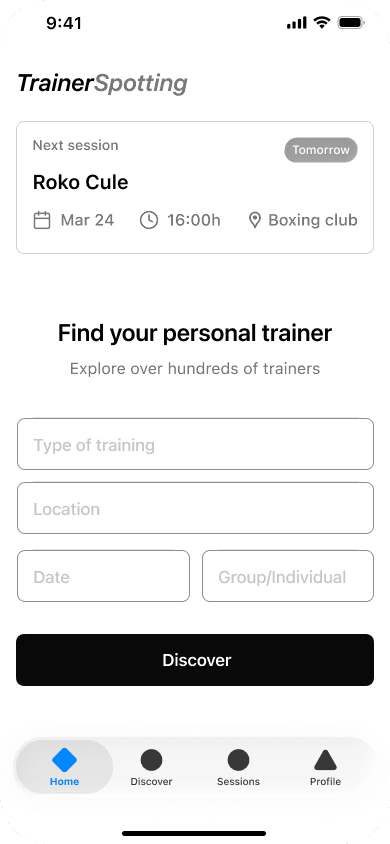
Design iterations focused on improving clarity and reducing friction in key flows.
Design iterations focused on improving clarity and reducing friction in key flows.
Final design
Wireframes used to define the core structure and navigation of the application.
Final design
To explore the visual direction of TrainerSpotting, the validated structure and user flows were translated into a high-fidelity mobile interface. The goal was to create a design that feels modern, focused, and easy to navigate, while supporting two different user perspectives within the same product.
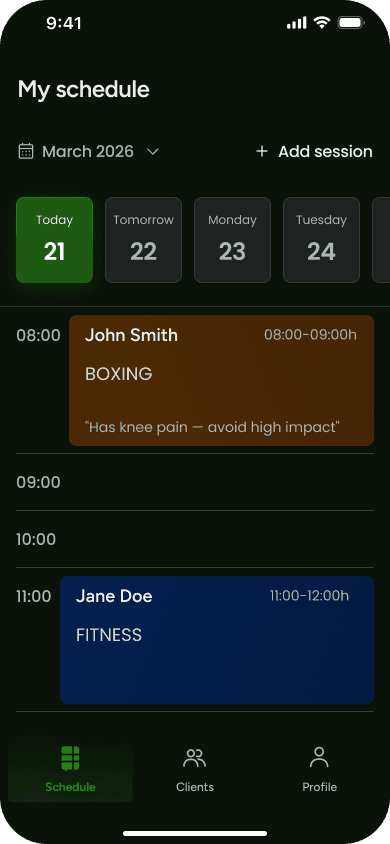
The high-fidelity screens below present key parts of the experience, including trainer discovery, trainer profiles, and session management tools for trainers.
To explore the visual direction of TrainerSpotting, the validated structure and user flows were translated into a high-fidelity mobile interface. The goal was to create a design that feels modern, focused, and easy to navigate, while supporting two different user perspectives within the same product.
The high-fidelity screens below present key parts of the experience, including trainer discovery, trainer profiles, and session management tools for trainers.
Discovery
Profile details
Management
High-fidelity screens showing trainer discovery, profile details, and trainer's session management
High-fidelity screens showing trainer discovery, profile details, and trainer's session management
Outcome
TrainerSpotting evolved from an initial exploration of trainer visibility problems into a structured mobile platform concept focused on connecting trainers and clients through a clearer and more accessible experience.
TrainerSpotting evolved from an initial exploration of trainer visibility problems into a structured mobile platform concept focused on connecting trainers and clients through a clearer and more accessible experience.
The project progressed through research, non-digital exploration, wireframing, prototyping, usability testing, iteration, and finally into a polished high-fidelity design direction. Core flows such as trainer discovery, profile browsing, booking sessions, and schedule management were designed and validated through interactive prototypes.
The project progressed through research, non-digital exploration, wireframing, prototyping, usability testing, iteration, and finally into a polished high-fidelity design direction. Core flows such as trainer discovery, profile browsing, booking sessions, and schedule management were designed and validated through interactive prototypes.
The final concept demonstrates how a complex system with multiple user roles can be simplified into an intuitive and cohesive mobile experience.
The final concept demonstrates how a complex system with multiple user roles can be simplified into an intuitive and cohesive mobile experience.
Reflections & Insights
One of the most valuable insights from the project came early in the process through exploring non-digital solutions. While community boards, local groups, and physical promotion could partially improve trainer visibility, they lacked the scalability and accessibility needed for a long-term solution. This reinforced the decision to approach the challenge as a digital product.
One of the most valuable insights from the project came early in the process through exploring non-digital solutions. While community boards, local groups, and physical promotion could partially improve trainer visibility, they lacked the scalability and accessibility needed for a long-term solution. This reinforced the decision to approach the challenge as a digital product.
Designing TrainerSpotting also highlighted the complexity of balancing two different user roles within the same application. Creating clear navigation and maintaining consistency between client and trainer flows required careful attention to hierarchy, structure, and interaction patterns.
Designing TrainerSpotting also highlighted the complexity of balancing two different user roles within the same application. Creating clear navigation and maintaining consistency between client and trainer flows required careful attention to hierarchy, structure, and interaction patterns.
Overall, the project strengthened my understanding of product structure, usability testing, iterative design, and designing systems that remain clear and approachable despite functional complexity.
Overall, the project strengthened my understanding of product structure, usability testing, iterative design, and designing systems that remain clear and approachable despite functional complexity.
View the Trainer Affinity map
Jump to
Jump to